





LThe Id Kan Mosque is both an important religious place and a scenic in Kashgar.
The famous Id Kah Mosque, covering an area of 16800 sq meters, is the largest mosque in China. It faces the east and is located in the downtown square. Before it was built, there had been a cemetery.In 1442 the ruler of Kashgar, Shakesimierzha first built a mosque here for the souls of his deceased relatives. In 1538, Wubuliadik expanded the mosque to commemorate his late uncle Mierzhaziwaili and converted it into a greater mosque for worshipping. Later it underwent construction and expansion several times, resulting in its present scale and grandeur.
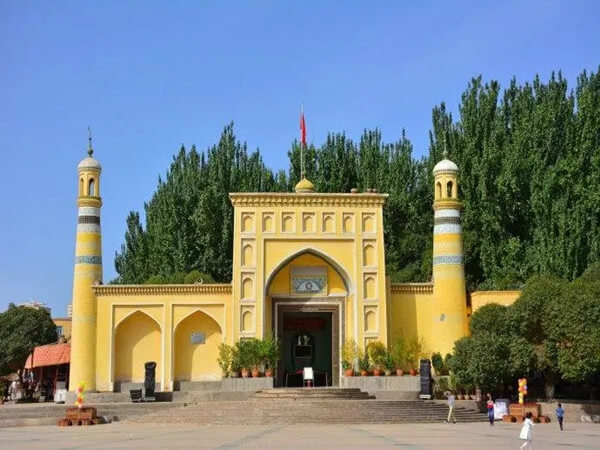
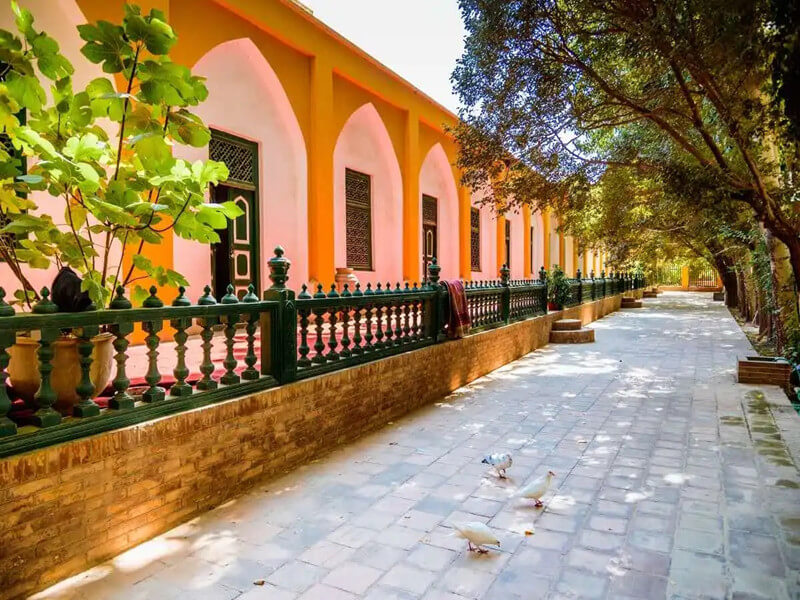
The Id Kah Mosque is composed of the worship hall, the lecture hall, the arched gateway, and other auxiliary structures. The 12-meter-high mosque gate is built of yellow bricks. On both sides of the arched gateway stand two unsymmetrical 18-meter-high minarets.
On the top of each, there is a new crescent moon. The imams in the mosque climb to the tower five times every day to summon Muslims to worship. At the gate of the mosque, there is an octagonal passage.On the left and right sides, there are passes leading to the courtyards of the mosque.
On each side of the courtyard, there is a row of lecture halls,36in all. They are mainly used for the chief imam to expound on the texts of Islam and for the Muslim students to learn the Kolas. The worship hall on a high place in the west of the mosque is divided into the inner hall and the outer hall.The top of the mosque is propped with 140green carved wooden dollars in a chequered pattern. The caisson ceiling is engraved with all kinds of flower patterns.
On the wall of the main hall’s center, there is a walled shrine with an interior sedan-like throne. During the time for worshipping, the chief mullahreads the verses standing in the shrine. On holiday the chief mullah gives sermons here. Muslims must take off their shoes while entering the hall regardless of social status. and come in by turns.
The importance of the Id Kah mosque does not lie in its scale, but in that it is a place of worship for all Muslims in the entire Xinjiang. Two or three thousand people come here worshiping every day. On Friday, the Juma day, male Muslims from far and near come here to worship, amounting to about 10000people. Om annual Greater Bairams, Muslims from the region come here. Muslims inside and outside the mosque can be as many as 30000-50000.