


Why Travel to the Tibet?
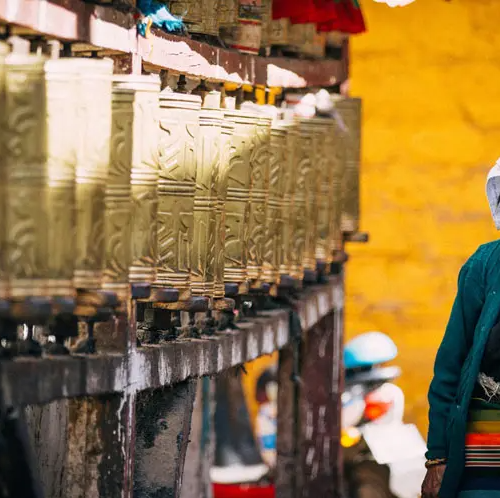
Tibet is located on the Qinghai-Tibet Plateau, known as the “roof of the world”, with an average elevation of more than 4,000 meters. It is an alpine “base camp” composed of a series of tall mountains. Five of the world’s 14 peaks above 8,000 meters are in Tibet, including the world’s highest peak, Mount Qomolangma. There are many sacred mountains and lakes in Tibet, Mount Kailash is the top mountains among them and also the center world in the hearts of believers. And the three holy lakes including Yamdrok, Manasarovar, and Namtso are just like bright pearls inlaid on this snowy plateau. Besides, Tibetan Buddhism has a history of 1,400 years and the Buddhist culture has penetrated into the life of the Tibetan people. The Potala Palace in Lhasa is the temple of Tibetan Buddhism, and the worshippers who come from thousands of miles to worship here and the monks who chant scriptures with the mouth of the prayer wheel make the thin air filled with a strong Buddhist atmosphere. Furthermore, in the eyes of self-driving enthusiasts, Tibet is definitely a “self-driving paradise”, whether it is the magnificent and dangerous Sichuan-Tibet Line, the Qingzang Line crossing the vast no man’s land, or the historic Tangbo Road, driving on the Qinghai-Tibet Plateau, there are always beautiful scenery to enjoy outside the car window.
Charming City – Lhasa
- Lhasa is located in the middle of the Tibetan Plateau, 3658 meters above sea level; as the capital of the Tibet Autonomous Region, which is also known as “Sunshine City”. At the same time, it is the political, economic, cultural and religious center of Tibet. Hence, it is a gathering place for the faithful, thousands of visitors from home and abroad come to Lhasa for seeking an inner peace.
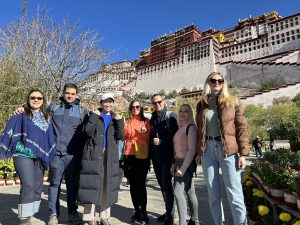
- The economy of Lhasa is also growing rapidly, transportation is getting more and more convenient. If you imagine. Lhasa is the original ecological world, then it may give you a different expectation in the heart; there are also high-rise shopping districts, dazzling streets, excellent hotels, banks, and shopping malls,etc.
- Lhasa city has many historical sites, Potala Palace, Jokhang Temple and Norbulingka are listed as World cultural Heritage. There are a lot of top tourist attractions such as Drepung Temple, Sera Temple, Tibet Museum, Barkhor Street, Namtso Lake, etc. Lhasa should be the most experience of slow life; here, you will unconsciously slow down the pace and rhythm, casually follow the local Tibetans walk on the Barkhor Street, make some good wishes. Sit down with a cup of sweet tea, soak up the sun in front of the holy Jokhang Temple, and chat with a few friends who will become your life-long congenial.
Must-visit Temples&Monasteries in Tibet
Tibet is a holy land, and it has a lot of famous and sacred temples and monasteries are worthy for your visiting.
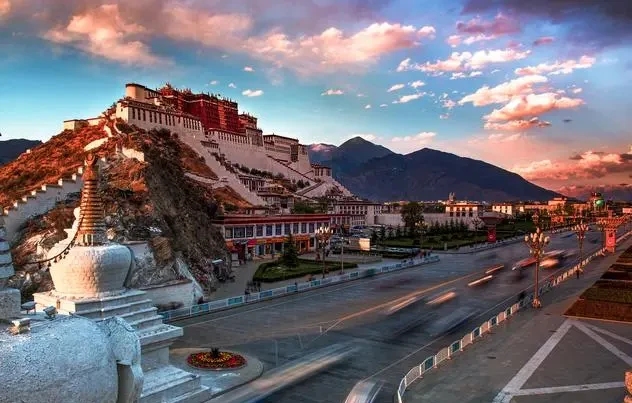
known as the highest and the most majestic palace in the world, and the symbolic architecture both in Tibet and Lhasa; it is mainly composed of the Red Palace and the White House, the highest Red Palace in the middle is an important place for religious ceremonies, and the surrounding White House is mainly a place for the activities of the Dalai Lama.
it is the end point of pilgrimage for Tibetan Buddhist believers, and it is also a far-famed holy land because of its famous statue of Sakyamuni brought by Princess Wencheng when she entered Tibet. If you climb up the third floor platform, you can have a panoramic view of magnificent Potala Palace and amazing Jokhang Temple Square.
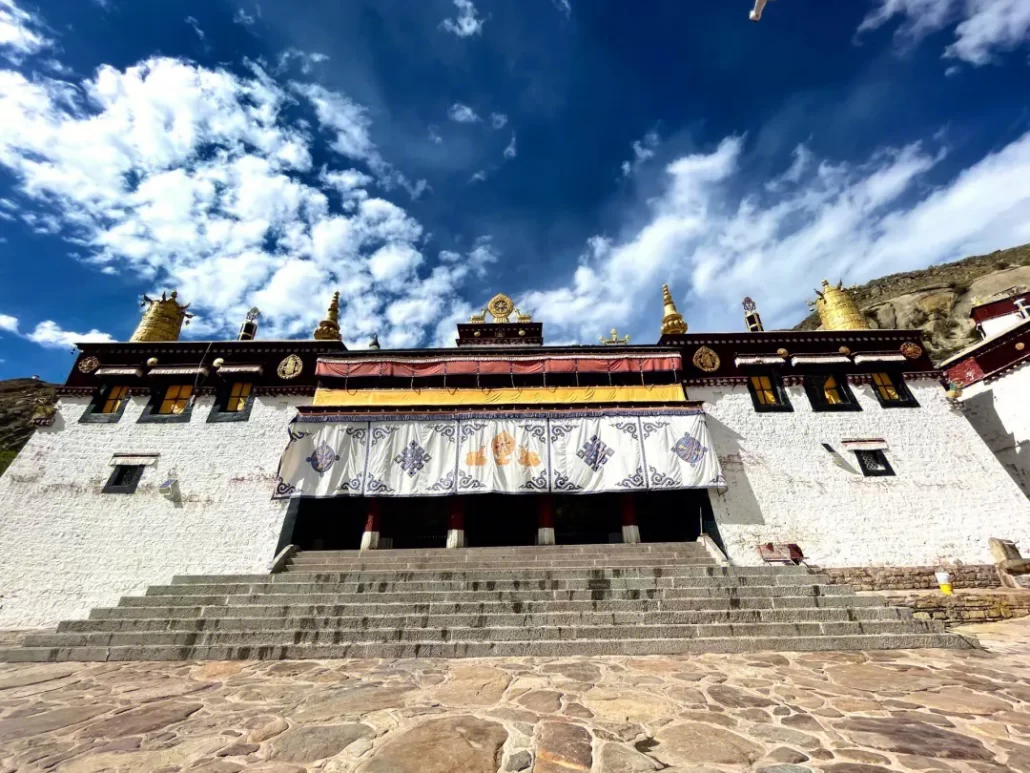
ogether with Drepung Temple and Gandan Temple, known as the three major temples in Lhasa, and here you can enjoy the Sutra debate ceremony if you have interest. Besides, there are also tens of thousands of Vajra statues preserved in the temple, some made locally and a few brought from the mainland or India.
located on the eastern slope of Nyima Mountain in the west of Shigatse, which has been the residence of Panchen Chen since the Fourth Emperor. On March 4, 1961, Tashilhunpo Temple was listed as a national key cultural relic protection unit by The State Council and there are 57 Buddhist halls and 3600 houses in the temple.
because the white building group covers the hillside, it looks like a huge pile of rice, so it is named “Zhe Clam”. What should not be missed in Drepung Monastery is the large-scale debate ceremony; the monks worked in pairs to debate the scriptures with exaggerated movements, which was very interesting.
the first of six Gelug monasteries, built by the founder of Gelug Tsongkhapa, is the ancestral temple of the Gelu sect. There are many well-preserved murals, sculptures, and cultural relics; in addition to Qianlong’s armor, there are lots of beautifully made silk woven thangkas, many of which are Jiangsu embroidery from the early Ming Dynasty.
Tibet Travel Permit, or Tibet Entry Permit, is foremost and compulsory for foreign passport holders to enter Tibet. Issued by Tibet Tourism Bureau, it is also called TTB permit. Without the permit, you can’t board a flight or train to Tibet or cross overland from Nepal, also will not be able to get other permits to continue to travel Tibet further.
The following groups of people have to carry a Tibet Entry Permit.
- Non-Chinese passport holders – US citizens, UK citizens, Australians, Canadians, Germans, etc.
- The Taiwan tourists, who do not have the valid identity card of China;
- The overseas Chinese, who do not have Chinese passport or ID card.
PS: Hong Kong and Macao Citizens can visit Tibet without Tibet permit.
Travelers cannot apply the TTB permit privately because of the Tibet tourism policy, visitors must book tour service from a certificated travel agency and let them help to apply the permit.
Work out a detailed itinerary in Tibet and contact a China travel agency.
Hire a tour guide and driver for your every day tour (the travel agency will arrange for you).
Send scanned copies of your valid passport and China visa to your China travel agency.
Offer an available address in China(hotel or local agency) to receive your permit.
Your travel agency apply for and obtain Tibet Travel Permit in Lhasa.
Your travel agency express the permit to you, or let a tour guide give it to you at airport or train station before your trip.
Note: Above policy doesn’t apply to diplomats, journalists, media photographer or government officials.
- By Plane
Before 1980s, there used to be only one airline company that operated flights to Tibet – Air China. As the rapid development of the tourism industry and economy, nowadays there are more and more airlines are able to operate flights to Tibet. There are several major Tibet airlines companies that have the most frequent Tibet flight schedules and also offer professional aviation services which are including Air China, Tibet Airlines, Sichuan Airlines, China Eastern Airlines, China Southern Airlines, Shenzhen Airlines, etc.
Lhasa Gongga International Airport is the only airport in Lhasa and the largest airport in Tibet. The airport is 70 km away from Lhasa city, about 1.5 hours by car. At present, most provincial capitals in China have direct flights to Lhasa, among which Chengdu, Chongqing and Xi ‘an have more direct flights.
- By Train
Lhasa Station is the terminus of the Qinghai-Tibet Railway. No matter from Beijing, Shanghai, Xi ‘an, Lanzhou or Chengdu to Lhasa by train, you need to transfer through Xining. The train journey from Xining to Lhasa takes about 22 hours. Currently, there are 7 major railway lines that run from inland China to Tibet, namely Beijing-Lhasa, Shanghai-Lhasa, Guangzhou-Lhasa, Chengdu-Lhasa, Chongqing-Lhasa, Lanzhou-Lhasa, and Xining-Lhasa.
- Drive Your Own Car to Tibet
At present, there are two ways to enter Tibet: the Qinghai-Tibet Highway and the Sichuan-Tibet Highway. Qinghai-Tibet Highway is a classic highway into Tibet, travelers will drive through some major cities including Xining, Golmud, Nagqu, Lhasa and can enjoy amazing scenery such as Qinghai Lake, Kunlun Mountain, Hoh Xil, Tanggula Pass, the source of the Yangtze River,etc. Hence, this way is mainly suitable for travelers who set out from the northwest. Sichuan-Tibet Highway is regarded as the most beautiful scenic avenue in China and it is a part of 318 National Highway; when travelers drive through major cities such as Chengdu, Garze, Nyingchi, Lhasa, can admire natural scenery of the Daocheng Yading, Lugu Lake, Nanjibarwa Peak, Nyingchi peach Blossom Sea. Therefore, this way is mainly suitable for visitors who set out from the southwest.
The Qinghai-Tibet Railway is the highest plateau railway in the world. Starting in Xining, the Qinghai-Tibet Railway passes through Golmud City, Kunlun Mountain Pass and the Tuotuo River, crosses Tanggula Mountain pass, enters Amdo, Nagqu, Dangxiong and Yangbajing in the Tibet Autonomous Region, and ends in Lhasa. The railway is 1,956 kilometers long, passing through Qinghai Lake, Kunlun Mountain, Hoh Xil, the source of Three Rivers, the grasslands of northern Tibet and the Potala Palace.
The Qinghai-Tibet Railway has brought Tibet into the railway era, strengthened the temporal and spatial links between Tibet and mainland China, and boosted the economic development of the Qinghai-Tibet Belt. It is known as the road of development, unity and happiness. Tibet is located in the southwest border of China, bordering India, Pakistan, Nepal and other countries, and its geographical position is very important. The completion and operation of the Qinghai-Tibet Railway has reduced the land transport time for trade between major cities in mainland China and Nepal from 12 to 18 days to less than one week, boosting the economic development of Nepal’s backward northern mountainous areas and helping Nepal to emerge independently on the world political stage.
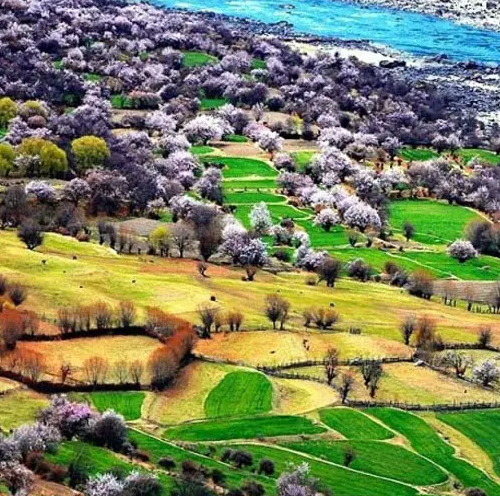
- The best time to visit Tibet is from May to October when is climate is moderate and the sun is full. From May to June, everything comes back to life. Because of delightful spring, the scenery of Tibet gets more attractive, especially the peach blossoms in Nyingchi, which are so picturesque that you can’t take your eyes away.
- From July to August, it’s the summer season with a large amount of rainfall in Tibet, but the temperature is still moderate and relatively humid. Therefore, you can still enjoy the natural lakes, mountains, and many other tourists attractions.
- From September to October, it’s the golden tourist season for Tibet; in Autumn, with a pleasant climate and plenty of sunshine, you can fully enjoy the clear and blue sky with beautiful views of snow-capped mountains, lakes, and grasslands.
- Winter is the off-season of tourism in Tibet, if you don’t like crowds and noisy scenic spots, it’s a nice to visit Tibet in winter. But, due to the low climate and snow mountains, some scenic spots are not available for visitors. If you want to visit Tibet in winter, be sure to take good measures to keep warm and pay attention to safety. In a word, there’s no stated season to visit Tibet, you are always welcomed to discover wonderful Tibet according to your personal interests and preferences.
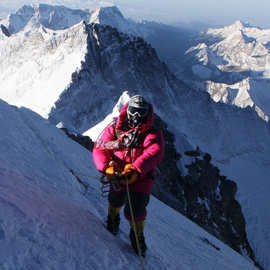
Mount Everest, also called Mount Qomolangma, which is the main peak of the Himalayas and the highest mountain in the world, located on the border line between China and Nepal, north of China’s Tibet, south of Nepal. It is also the center of China’s Qomolangma Nature Reserve, which spans four counties and Nepal’s National Park. Mount Qomolangma is a giant pyramid, mighty and majestic, its terrain is extremely steep and the environment around the mountain is very complex. The rock face of Mount Qomolangma is 8,844.43 meters high, and the summit is located in China. Mount Qomolangma is not only a challenge for climbers, but also a paradise for tourists. Here you can enjoy one of the most beautiful natural landscapes in the world. There are six climbing camps on the north slope of Qomolangma, namely the base camp at an altitude of 5,200 meters, the middle camp at an altitude of 5,800 meters, the forward camp at an altitude of 6,500 meters, the number one camp at an altitude of 7,028 meters, the number two camp at an altitude of 7,900 meters, and the commando camp at an altitude of 8,300 meters. Moreover, at Mount Qomolangma you can also enjoy the most gorgeous and incredible sunrise.
Ngari is known as the “roof of the world” and “the most Tibetan part of Tibet.” It may well contain the most inaccessible part of the globe outside of polar regions. It is the mysterious dreamland of Tibet, and Mount Kailash is known as the “head of the sacred mountains” and the “center of the world” by the four major sects of Tibetan Buddhism, Bon, Hinduism and Jainism.
Mount Kailash is regarded as the “roof of Tibet”, which is located in the southwest border of China and in the southwest of Qinghai-Tibet Plateau, with an average altitude of 4,500 meters.
Every year, pilgrims from India, Nepal, China, and many other countries visit Mount Kailash for a yatra (a pilgrimage to a holy site) and to do a kora (a sacred walk) around the sacred mountain.
Due to its distinctive topographic features, it is also a paradise for travelers and photographers. And in order to eliminate confusion and sin, and for the faith in their hearts, Tibetans also worship at Kailash. Whether it is to feel the power of religious belief, or to the incredible scenery along Ngari, or the mysterious ancient civilization, as long as you adapt to high altitude reaction, and overcome the harsh climate during the mountain trekking journey, you will definitely find the inner peace of yourself and achieve your long-cherished pilgrimage wish in your life.