





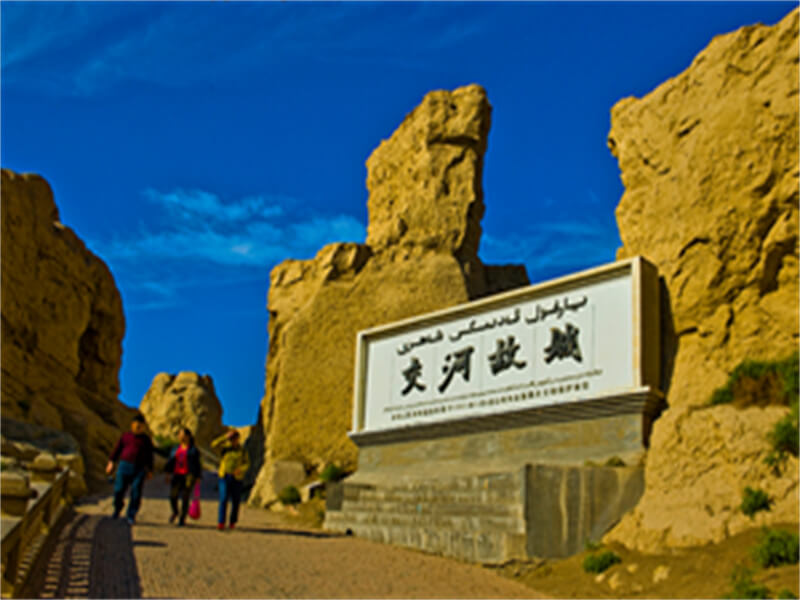
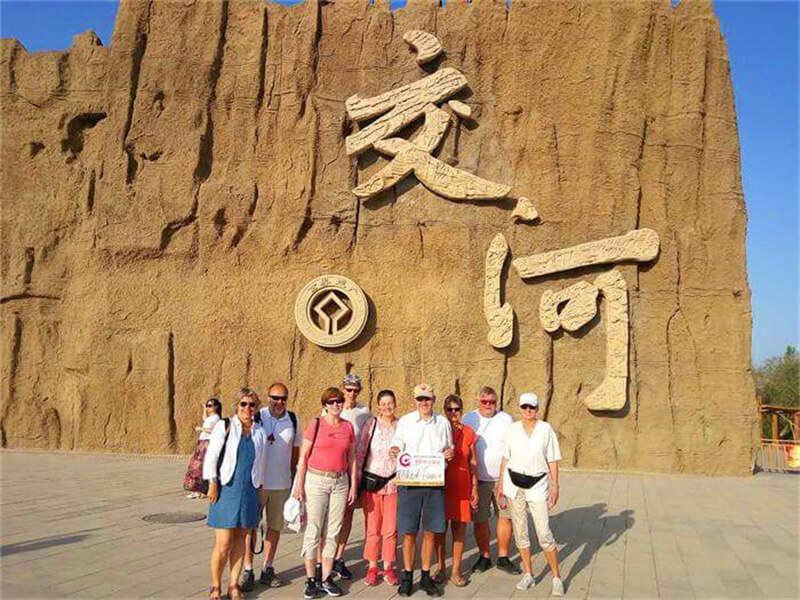
Turpan features a breathtaking landscape and diverse culture. Known as the ” perfect ruin of earth building,” Jiaohe Ruins is used to be the capital city of the former Jushi State. In Chinese, “Jiaohe” means Intelligence is bound to exist where two rivers meet. The historical records and excavation reveal evidence of a prosperous ancient trading center and military stronghold from 1,600 years ago. Owing to the arid climate and remote location, Jiaohe remains relatively intact, leaving us a rare example of an earthen castle, the largest, oldest and best-preserved earthen city in the world.
Jiaohe Ruins stands isolated on a 30-meter-high plateau in the Yarnaz Valley, 10 kilometers east of Turpan. The whole city of Jiaohe Ancient City stretches about 1650 meters from south to north and 300 meters from east to west. With history about 2,000 years, the Jiaohe Ancient City was controlled by the residents of Gaochang.
Turpan Jiaohe is a city without walls and trees, and it used to be one of the most prosperous cities on the ancient silk road. It is an ancient city in the western region that enjoys equal popularity with Loulan Ancient City, known as “Oriental Pompeii City.” At present, this ancient city is one of the most well-preserved urban relics in China for more than two thousand years. When you visit the Jiaohe Ruins, you can not only enjoy the culture of western regions but also experience the vicissitudes of history, which is entirely worth a visit.
The History of Jiaohe Ruins:
The Building Structure of Jiaohe Ruins:
What to Visit in Jiaohe Ruins:
1. Cultural Relics Exhibition Hall of Jiaohe Ruins: Many cultural relics have unearthed in Jiaohe Ruins, such as the Lotus Eaves tile of Tang Dynasty, Lotus Sutra, Human Face Pottery Lamp, etc. Therefore, under the south entrance of the ancient city, there is a Tang style building – Jiaohe Ruins Cultural Relics Exhibition Hall, which displays the sand table, historical materials, and unearthed cultural relics.
2. East Gate of Jiaohe Ruins: The east gate is integrated with the city and stands on the Loess cliff bank. So far, the ruins of the gate are well preserved.
3. City Square: In ancient times, the city square is the place where Jushi people carried on the trade. The square is close to the official district. However, there is a mysterious cemetery in the north of the official community. It has no epitaph and the record of history. So far, it is a mystery.
4. Jiaohe Temple: Situated in the west of the avenue, the low buildings with sparse small temples were residences for commoners, while the large ones in the east were for aristocrats and troops. At the end of the avenue stands a large, well-preserved Buddhist temple, Jiaohe Temple, with an area of 5,000 square meters.
5. South Gate Remain lies on the cliff ae south end of the city, with a gateway in the east-west direction, measuring 6.8-meter-wide and 11-meter-long. The north wall was made of earth measuring 14-meter-high and houses remains of 2 vaulted niches. The south wall is 5.2 meters high, and houses remain of 4 arched niches. Behind the gate is a semi-enclosed 6-meter. High defensive wall with courtyard wall body and plinth inside, South Gate served as the main gate of the Yar City, linking between the Central Avenue of the inner city and roads south of the outer city.

The Layout of Jiaohe Ruins
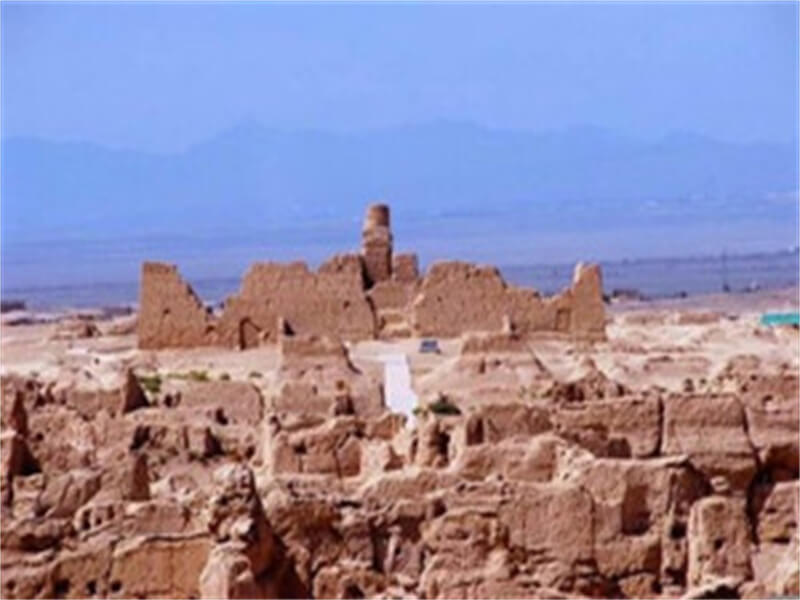
The layout of Jiaohe Ruins is divided into three parts, at the north end of the main road, you will see a large-scale monastery and the magnificent towers on the north of the city, which may be the pagodas for the burial or worship in ancient times. Continue to visit; you will see the magnificent underground buildings in the southeast, with an 11 square meter patio on the top, according to the investigations, it’s presumed that the official Yamen of Tianshan County may follow the residence of Anxi Frontier Command.
Besides, there are many handicraft workshops in the west. On both sides of the main road are numerous terraces, behind which are “fangs” divided by crisscrossing short lanes: the residential sites and handicraft workshops such as textiles, wine-making, and shoemaking. By the way, on the east side of the ancient city, there were once military barracks, leaving behind old houses with various functions.
The Best Time For Photography in Jiaohe Ruins:
Every sunset is the most appropriate time to visit Jiaohe Ruins; at this time, the walls are yellowish and reddish, which is the perfect time for photography.
How to Get to Jiaohe Ruins:
1.Travelers can take bus No. 1 or No. 101 to the terminal at Xincheng Road, Turpan, or take a taxi (about 20 yuan) to Jiaohe Ruins.
2.It takes about 2hrs and 50 mins (194.7 km ) to drive from Urumqi to Jiaohe Ruins.
3.It takes about 30 mins (18 km ) to drive from Turpan Airport to Jiaohe Ruins.
4.It takes about 28 mins (19.4 km ) to drive from Turpanbei Railway Station to Jiaohe Ruins.