



Qinghai Tours

Qinghai is unique for its magnificent natural scenery on the Qinghai-Tibet Plateau, which is knowns as“roof of the world” , the largest plateau in China and the highest in the world. At the same time, Qinghai is the birthplace of the world-famous Yangtze River and the Yellow River; and every year it attracts a lot of visitors to the China’s largest inland saltwater lake-Qinghai Lake. Qinghai has a golden sea of flowers, every July and August thousands of acres of rape flowers attract many tourists, and it is also a multi-ethnic area where you can explore more about different cultures and folk customs of ethnic groups.

15 Days Excellent China Tour

Gansu and Inner Mongolia tour can bring you a memorable experience of the Yellow River culture and Silk Road culture…
15 Days Excellent China Tour

Gansu and Inner Mongolia tour can bring you a memorable experience of the Yellow River culture and Silk Road culture…
15 Days Excellent China Tour

Gansu and Inner Mongolia tour can bring you a memorable experience of the Yellow River culture and Silk Road culture…

15 Days Excellent China Tour

Gansu and Inner Mongolia tour can bring you a memorable experience of the Yellow River culture and Silk Road culture…
15 Days Excellent China Tour

Gansu and Inner Mongolia tour can bring you a memorable experience of the Yellow River culture and Silk Road culture…
15 Days Excellent China Tour

Gansu and Inner Mongolia tour can bring you a memorable experience of the Yellow River culture and Silk Road culture…
Qinghai Tourist Map

FAQs

1. What are the climate features in Qinghai?

Qinghai is located in the northeastern part of the Tibetan Plateau, with an average altitude of about 3,000.

  • In spring (April to May), nighttime lows are around minus two degrees, with localized high altitude areas around minus five degrees. The maximum temperature (in the afternoon under good weather conditions) is around 20℃. Spring is windy, with snowfall in the mountainous regions, and there is a big difference between morning and evening temperatures.
  • In summer (June to August), is actually the best season to travel to Qinghai, with a cool and pleasant climate. The maximum temperature is around 28 to 30℃, with a 2-3℃ lower around Qinghai Lake.

  • In autumn (September to October), the weather in Qinghai turns cooler and the temperature drops, with occasional snowfall at high altitudes, with a minimum temperature of about 6℃ and a maximum of about 20-25℃.

  • In winter (November to March), the lowest temperature is about 20℃ and the highest is about 15℃above zero, which is cold when the wind blows, and there is a lot of snowfall in high-altitude mountainous areas.

Qinghai Lake, located in the northeastern part of the Qinghai-Tibetan Plateau in China’s Qinghai Province, is known as the Western Sea, covering an area of 4,952 square kilometers, with an elevation of 3,260 meters above sea level.

The starting point of cycling around the lake is generally Xihai Town,  because it happens to be at the intersection of 315 National Road and Huanhu East Road, where has the richest bicycle rental and accommodation resources along the Qinghai Lake.

The order of the cycling is generally clockwise, starting from Xihai Town, in turn through Huanhu East Road, 109 National Road, Huanhu West Road and 315 National Road. And you can cycle around the lake from May to October each year.

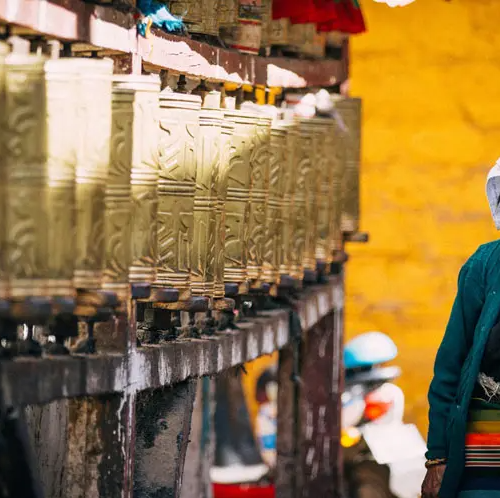
The main ethnic minorities living in Qinghai are the Tibetans, Hui, Tu, Salar and Mongols, of which the Tu and Salar are unique to Qinghai.


  • The World’s Largest Yak Black Tent.
  • The World’s Largest Wheel.
  • The World’s Largest Outdoor Salt Sculpture Art Group;
  • The World’s Earliest Existing 100-meter Single-Arched Bridge on the Plateau.
  • The World’s Largest Mani Pile.
  1. Sunscreen, UV is very strong, easy to sunburn, need to prepare sunscreen products with a high SPF, and hats, umbrellas and other items.
  2. Prevent altitude sickness and bring essential travel medicines.
  3. Prevent the changeable weather, different altitudes, the temperature difference is relatively large, according to their own physical condition to carry some thick clothing, such as outdoor protective clothing.
  4. Respect for the customs and habits of local minorities.